Emergency action to protect lifesaving foreign aid
The devastation of global health and development programs this spring was unlike anything in our history. But your deep, targeted bipartisan congressional advocacy has helped hold the line and start to rebuild.
There is no minimizing that the ongoing, deadly impacts of administration’s rash actions in 2025 on foreign aid. Yet the breakthroughs we have seen this year show what’s still possible, and what’s required to make it a reality.
This page has chronicled all that’s happened in 2025. For 2026, stay tuned on the RESULTS blog and Volunteers Hub for all your actions in the new year.
RESULTS has a 45-year history of building bipartisan will in Congress to end global poverty. We’ve never let anything stop us before, and we won’t let up now.
Latest updates
The devastation of global health and development programs this spring was unlike anything in our history. By the middle of 2025, the U.S. administration had:
- Terminated most existing bilateral health, education, and poverty programs
- Tried to zero out or slash future funding, and proposed clawing back past investment
- Shut down the main U.S. agency for global development
- Withheld promised funding to the Global Fund to Fight AIDS, Tuberculosis and Malaria
The harmful consequences of these actions are enormous. But your deep, targeted bipartisan congressional advocacy has helped hold the line and start to rebuild:
- Dozens of terminated programs were restarted across Africa, Asia, and Latin America
- The House fully restored or boosted funding for global health
- The Senate rejected proposed cuts (recissions) to key global health work
- The U.S. reaffirmed its 1:2 matching commitment the Global Fund, with a new multiyear pledge
All year long, your grassroots advocacy has made a difference. In the face of enormous challenge, you didn’t slow down. You mobilized Congress to respond at every step.
There is no minimizing that the administration’s rash actions continue to have deadly impacts around the globe. It will take years of focused advocacy to fully recover. Yet the breakthroughs we have seen this year show what’s still possible, and what’s required to make it a reality.
This blog has chronicled all that’s happened in 2025. For 2026, stay tuned on the RESULTS blog and Volunteers Hub for all your actions in the new year.
RESULTS has a 45-year history of building bipartisan will in Congress to end global poverty. We’ve never let anything stop us before, and we won’t let up now.
At midnight on October 1, we officially entered a federal government shutdown. Congress failed to pass the FY26 Appropriations bills or a continuing resolution (CR) before the end of the fiscal year. As a result, many government programs are paused or will soon grind to a halt. As you know, many global health and poverty programs are already suffering from months of reduced staff and withheld funding. This will be another blow, but doesn’t fundamentally change the state of affairs.
Senate Republicans need several more Democrats to join in to pass their CR, but Democrats are hoping to force action on healthcare. Congress will continue to negotiate on a CR or an FY26 budget, and we cannot let global health be left out. The House bill released this summer included strong funding levels for global health. But the Senate numbers remain uncertain.
Regardless of the shutdown, our asks have not changed. We remain focused on ensuring Congress funds high-impact global health and education programs. They must finish their job on appropriations and maintain their power of the purse. Any FY26 budget legislation must prioritize foreign aid. Congress must also add guardrails to make sure the Administration actually spends the money as directed.
One of the reasons many of these programs have survived repeated rounds of cuts is because of your advocacy. Your letters, calls, LTEs, and lobby meetings have helped protect global health accounts. Continue to urge your members of Congress to pass a budget that fully funds maternal and child health, nutrition, TB, global education, Gavi, and the Global Fund. By investing in global health, they can save millions of lives and build more resilient health systems and healthier communities.
Just weeks before the end of fiscal year 2025 (FY25), the Trump Administration sent another rescissions package to Congress. They intend to cancel $4.9 billion in foreign aid that was appropriated by Congress. Like the last rescissions package, this money was already signed into law by Trump himself in March. But now, funding for global education, food aid, and more is at risk.
Normally, Congress has 45 days to consider and vote on the rescissions package. During those 45 days, the money remains unspent. But because it’s less than 45 days until the end of FY25, the funding will expire before it can be unfrozen. Regardless of what Congress does, the administration will argue that after September 30 the funding cannot be paid.
This illegal tactic by the administration is known as a “pocket rescission.” It is a blatant move to usurp congressional authority. The White House is overruling the will of Congress and ignoring their power of the purse.
The Supreme Court has been asked to weigh in. Chief Justice Roberts temporarily paused a lower court ruling that required the State Department to spend the FY25 money. He asked for more information on the case by today.
While the Supreme Court deliberates, Congress also still has a role to play. Some Republican senators have already spoken out against pocket rescissions. It weakens their constitutional power.
Members of the Appropriations committees are particularly affected. The administration is directly undermining their role in deciding funding levels. Chair of the Senate Appropriations committee Senator Susan Collins (R-ME) emphasized:
“Article I of the Constitution makes clear that Congress has the responsibility for the power of the purse. Any effort to rescind appropriated funds without congressional approval is a clear violation of the law.”
On top of rescissions, Congress also needs to pass a continuing resolution (CR) by September 30. This CR would extend FY25 funding levels, to give them more time to negotiate FY26 funding levels. Congress could include language extending the expiration date for FY25 funding. This would give Congress time to vote against the rescissions and ensure the money is spent.
This pocket rescission affects $4.9 billion in foreign aid. Importantly, it is also a threat to democracy and the power of Congress. And if it passes, more rescissions requests will follow. Take action now. Urge your members of Congress to reject rescissions and ensure appropriated money is spent as directed.
Your advocacy on appropriations is working. We just got an early, powerful sign that Congress might stand up for global health.
Yesterday, the House of Representatives Appropriations Committee advanced its bill for fiscal year 2026 (FY26) global health and poverty funding. It is a mixed bag for sure. But you all should be very proud.
The Republican-led House proposed HIGHER global health funding levels than they did last year. This is an extraordinary sign in today’s context.
Don’t forget: this spring the President’s budget request tried to zero out many of these programs. For others, the administration wanted to cut them in half. This new bill is a clear rebuke. It is a signal that Congress understands the critical importance of global health in foreign aid.
All of our global health priorities were either fully restored or increased. Every single one.
You likely saw that the administration recently promised to cut Gavi, the Vaccine Alliance funding completely. However, the House bill maintains the current level of $300 million. The White House has also threatened the Global Fund to Fight AIDS, Tuberculosis and Malaria. But the House proposed $1.5 billion, more than they requested for FY25.
The House bill even calls for an increase for global nutrition. It also maintains FY25 funding levels for tuberculosis and maternal and child health. Unfortunately, overall global education received a modest cut. But, the House maintained full funding for the Global Partnership for Education, which many of you have advocated for to lawmakers. The administration quite literally tried to terminate nearly all education work this spring. With this legislation, the House is saying ‘no’. The House bill gives us a chance to rebuild. Critical maternal and child report language that RESULTS supports was also included.
Below is a chart comparing the new House bill against the President’s request, the FY25 House bill, and the FY25 enacted numbers.
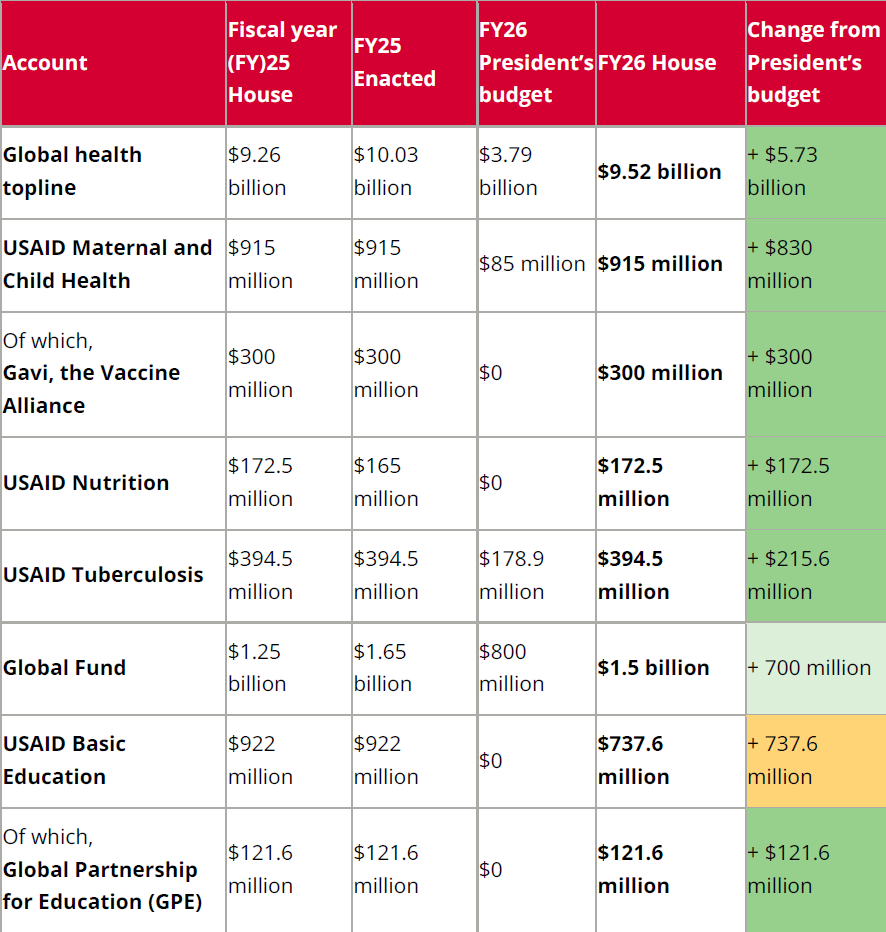
However, there are also lots of very harmful proposals in this proposed legislation. Overall, the bill has a topline cut of 22 percent. This includes steep funding cuts to key humanitarian and development programs. There are many harmful policy restrictions. The bill also proposes massive cuts to other parts of the State Department, which is the agency now in charge of foreign aid (with the U.S. Agency for International Development (USAID) dismantled). We’ll be pushing back wherever needed.
The funding fight itself is also far from over. Next we turn to the Senate. And ultimately, we will need Congress to make sure these funds are actually SPENT on high-impact programs.
Amid the destruction to global health and poverty programs, this bill is sign that your advocacy is working. Bipartisan leaders have listened to you when you share your stories and values, and they are starting to take action. They have read the Dear Colleague letters you worked on, and listened to what you told them in meetings. It’s not a coincidence that your priority accounts have escaped the worst of the cuts. Keep it up, and take action now to let your members of Congress know why global health funding matters to you.
Rescissions passed, but just barely. And we helped protect global health.
As you may have seen, the White House rescissions package passed in both the House and Senate. For more background, see rescissions blog post from June 3rd and update on June 24th.
Without a doubt, this sets a bad precedent.
Congress agreed to White House demands for cuts to a budget they already passed into law. This opens an unsettling door for more rescissions in the future. It weakens Congress’ constitutional “power of the purse.” It also threatens long-standing, bipartisan investments in global health and poverty reduction. This is deeply troubling.
But this bill only barely passed. And there were loud objections.
In both chambers, it came down to the wire — squeaking through at the last possible moment and by a slim margin. Throughout the process, both Republicans and Democrats spoke out against the White House overreach. There were many concerns about the lack of transparency. Bipartisan lawmakers raised these objections clearly and publicly.
While this bill passed, the resistance against it sent a message that the administration must think twice before attempting a similar maneuver again.
Republican and Democrat Senators drew a line on global health funding.
As mentioned, Senators successfully removed some of the most dangerous global health cuts from the rescissions bill. That means U.S. funding for HIV, tuberculosis, and malaria were preserved. So were funds for maternal and child health, nutrition, and international food assistance. Senators on both sides of the aisle drew a firm line: these programs are too important to cut.
This win didn’t happen by chance. This kind of bipartisan defense is a direct result of persistent, strategic advocacy. It’s a clear sign that our voices, alongside those of advocates across the country, are making a difference.
This doesn’t change the problem with rescissions passing. But, it does keep some lifesaving programs for millions of people safe. It also sends a clear signal for the future that these programs are off limits.
And that wasn’t the only sign of hope for global health this week.
Earlier in the week, there was promising news on appropriations for Fiscal Year 2026 (FY26). The House subcommittee responsible for foreign aid funding passed its spending bill. The final details are not out yet — but once they are next week, we’ll have a full summary for you. What we do know so far is very promising. This House subcommittee proposed HIGHER global health funding levels than they did last year. This is an extraordinary win in this context. Your advocacy to Congress helped show them that their constituents do not want to back away from global health. This is exactly why we’ve continued to focus on Congress.
The “top-line” numbers are strong. They specifically call out support for two key partnerships: Gavi, the Vaccine Alliance and the Global Fund to Fight AIDS, Tuberculosis and Malaria. It also includes funding for maternal and child health, nutrition, tuberculosis, and PEPFAR (HIV/AIDS). This is a powerful rebuke of the administration’s earlier proposal. The White House asked to zero out some of these programs and cut others in half.
The full breakdown of funding line by line should be available soon. And we’re still waiting for the House to release some key policy details, which will shape our final assessment of the bill. Stay tuned for another update next week.
Of course, it’s not all good news. But there are signs that our advocacy is working, and it must continue.
The House spending bill may have spared global health programs, which is great news. But (like with rescissions), it still includes steep funding cuts to key humanitarian and development programs. The bill also includes massive reductions to other parts of the State Department and many harmful proposed policies. We will keep pushing back wherever needed.
Today’s vote on rescissions is a setback. There’s no denying that this bill will have harmful consequences. But it’s not a defeat.
It’s a reminder that we are operating in a tough environment. But that smart, sustained congressional advocacy can still shape outcomes. It’s a reminder that bipartisan support for global health is real and still remains strong. And it’s a reminder that when we raise our voices together, we can protect programs that are saving and improving lives both around the world and at home.
We’ll check back in next week with more. Thank you for being an important part of this work.
Some health programs are safe – but keep voting NO on rescissions
There’s still time to make your voice heard on this critical decision. Contact your Senators and Representatives now and urge them to vote NO on the rescissions package.
Last night, the Senate took an important step to protect global health. Thanks to your advocacy and sustained pressure, Senators removed some of the most dangerous cuts to lifesaving programs from the rescissions bill. Funding for HIV, tuberculosis, malaria, maternal and child health, nutrition, and international food assistance is no longer targeted by this package.
This is no small victory. It’s a clear sign that your voice, alongside those of advocates across the country, is making a difference. Senators on both sides of the aisle drew a firm line: these programs are too important to cut. That kind of bipartisan defense doesn’t happen by accident. It’s the result of years of persistent advocacy and education.
But this fight is not over. Two things remain true:
- There is strong bipartisan support for key global health investments.
- The rescissions package, even in its amended form, is still deeply harmful and dangerous. We remain firmly opposed to it.
Other critical international health, education, and development programs are still at risk. And the bill undermines Congress’ constitutional power of the purse by allowing the administration to dictate cuts to funding that Congress already approved. Last night, Senators from both parties called this a serious threat to congressional authority and democratic accountability.
Unfortunately, despite these warnings, the rescissions bill is still moving forward in the Senate. Votes on amendments are expected later today. If it passes, the package will head back to the House for consideration. This means we need every member of Congress, in both chambers, to hear from constituents urging them to oppose it.
The message is simple: Vote NO on rescissions.
For calls in to congressional aides, here is a suggested message:
“I’m asking you to defend Congress’ role over spending. Please vote NO on rescissions. The Senate rightfully stood up to stop deep cuts to some key global health programs last night. This is a good first step. But it doesn’t change the underlying problem with the bill. The rescissions package still strips money from other health, education, and development programs. And it sets a dangerous precedent for congressional authority over spending. We continue to ask you to vote NO.”
We’ve seen what’s possible when constituents speak out. Let’s keep that momentum going.
On July 1, 2025, the United States Agency for International Development (USAID) officially ceased to exist. The White House ended some programs permanently. Others were transferred to the State Department, stripped of key staff and oversight. This leaves little capacity to carry those remaining programs forward.
This is a devastating loss for global health, humanitarian aid, and the world. But it’s more than an institutional loss. It’s a threat to millions of lives — people who relied on American aid to survive, and millions more who now face an uncertain future.
USAID was never perfect. That’s why RESULTS advocates have worked with Congress for decades to improve the impact. With many bipartisan congressional allies, we’ve helped make USAID more equitable, and cost-effective. Its mission to end poverty mattered, and still does. We won’t stop fighting.
We demand that Congress reject rescissions and fund lifesaving programs
We will keep pushing the U.S. government to uphold the Constitution, including Congress’ power to control the budget.
- The Senate must reject the proposed rescissions package, which narrowly passed the House (214-212) and would take back billions of dollars for health and development that Congress approved for Fiscal Year (FY) 2025 and President Trump signed into law in March 2025.
- Congress must ensure the administration spends the funds already approved for FY2024.
- Congress must protect and grow support for global health and development programs in the final FY2026 bills and beyond.
Misinformation and falsehoods about USAID and its dismantling are everywhere
On the agency’s last day, Secretary Rubio claimed, “USAID has little to show since the end of the Cold War.” That is simply false. A recent study published in The Lancet, a leading medical journal, found that USAID funding helped prevent over 90 million deaths in the last 21 years — including 30 million children under age 5. Experts now warn that these steep U.S. aid cuts could lead to more than 14 million deaths in the next 5 years.
On July 1, the administration fired most of USAID’s workforce. Staff were not reassigned. Only 17 percent of programs and 6 percent of staff were transferred. The State Department did not emerge unscathed from this damage. Also on July 1st, the administration fired 15 percent of State Department employees. This leaves the department’s capacity to manage foreign aid weak and unstable. These rushed actions have gutted the government’s ability to provide oversight on the few programs that remain active. They have no clear strategy for building anything new. Lifesaving work has already ground to a halt across dozens of countries.
Your voice matters
This isn’t just bad policy. It’s a deadly decision that communities will feel for generations. But we are not giving up. Your actions right now are critical. Standing up for funding will help decide the future of foreign aid. For global aid, the appropriations process is the most important thing before Congress right now. Congress must defend what they already set aside and secure new resources for the future. Throughout the next month, Congress will make those life-and-death decisions.
Your member of Congress needs to hear from you.
“For in the final analysis, our most basic common link is that we all inhabit this small planet. We all breathe the same air. We all cherish our children’s future. And we are all mortal.” – President John F. Kennedy, June 10, 1963
The U.S. has a long, proud bipartisan legacy of helping to end preventable child and maternal deaths. Since January, though, the Trump Administration has repeatedly undermined that important work. The administration once promised to protect lifesaving programs. But its budget request for next year includes major cuts to both maternal and child health programs.
Today, leaders from around the world met in Brussels to pledge support for Gavi, the Vaccine Alliance. The U.S. didn’t just miss the moment–it sent a troubling message. In a pre-recorded address, Health and Human Services Secretary Robert F. Kennedy Jr. said the Administration plans to stop supporting Gavi. He also accused Gavi of ignoring vaccine safety and science. Let’s be clear: Gavi makes decisions based on the best available science. Its process is rigorous, transparent, and led by independent experts.
Gavi plays a critical role in making sure millions of children around the world get routine vaccines. The summit in Brussels was a moment of global unity. It was another step toward a world where no child dies from a vaccine-preventable disease. Over the past 20 years, Gavi has helped immunize more than 1 billion children and prevent more than 18 million future deaths. It’s one of the most effective, lifesaving investments the world has ever made. With full support, Gavi plans to reach the next billion children in half the time. That is what science and public health leadership look like.
The good news is, Congress can still lead where the White House has failed. Congress has the power–and responsibility–to decide the federal budget. The House and Senate haven’t finished work on the Fiscal Year 2026 funding bills for foreign aid and global health. The Senate also hasn’t voted on a bill that would take back billions in already approved funding from Fiscal Year 2025. (The legislation to cancel 2025 funds is called rescissions, see the June 24 update of this blog for more).
This is a key moment. It’s up to us to remind lawmakers that their constituents expect them to act. They must speak out and do what’s right for kids and families everywhere
We’ve seen it again and again: when constituents speak up, Congress listens. Over the years, advocates like you have helped build strong, bipartisan support for Gavi in Congress. More than 100 lawmakers from both parties have signed letters each year calling for more funding. Just one year ago, Dr. Jill Biden announced a historic U.S. pledge of at least $1.58 billion over five years to Gavi. This was the largest U.S. Gavi pledge ever and the first to cover a full five years. That kind of bold action was only possible because of Congress’s long standing support. Your advocacy drives that support. The $1.58 billion pledge may have come from the Biden Administration, but it had strong backing from both parties in Congress. It also helped create momentum for other donors. Many of them announced robust pledges in Brussels today.
Now, with the U.S. government budget process underway, lawmakers need to hear from us again: keeping this promise matters.
Earlier this month, the Trump Administration sent a rescissions package to Congress. This is the legislation that will claw back billions of dollars for Fiscal Year 2025 (yes, the current Fiscal Year — that we’re partway through). Congress has already approved this spending. President Trump signed it into law himself. The White House wants global health, education, and general aid dollars struck from this same budget.
The latest is that on June 12, the House of Representatives unfortunately approved the rescissions package. It was a narrow (214-212) vote. This means that RESULTS advocacy to fight rescissions must focus on the Senate.
All but four Republican representatives in the House voted in favor of rescissions. All democrats present voted against. Without a doubt, your advocacy helped make this vote as close as it was. If not for hearing from constituents like you, it would have been more of a “landslide.” While Speaker of the House Johnson called this a “manifestation of DOGE cuts,” it is technically unrelated to the spending cancelled by DOGE (likely, unconstitutionally). The funds the White House withheld as it notoriously dismantled USAID earlier this year come from previous fiscal years, including Fiscal Year 2024.
It’s a refrain we advocates must keep singing to ourselves: Congress has the power of the purse. The White House is powerful, but Congress has a duty to its constituents. Senators must hear a loud call from their voters to reject rescissions. We know how to do this, and we can do this. Here are resources for action and for asking to meet with your Senators.
On top of rescissions, the White House also issued its Fiscal Year 2026 budget request. It proposes reversing decades of U.S. support for lifesaving global programs that help primarily children. It entirely zeroes-out funds for maternal and child health. There is no funding for nutrition except in cases of humanitarian emergencies. It withdraws funding from one of the most successful global aid partnerships of all time: Gavi, the Vaccine Alliance. Gavi has helped vaccinate over half of the world’s children and prevented more than 18.8 million future deaths. Millions of children will live to see their fifth birthdays and even adulthood thanks in part to U.S. assistance. And the White House wants to cut off support.
Altogether, the message is simple: do not change support for effective global aid, in fact, increase it. The funds appropriated for foreign assistance in Fiscal Years 2024 and 2025 must be spent. These programs also drew overwhelming bipartisan support in congressional Dear Colleague letters for Fiscal Year 2026. Congress must stand up for them now.
The White House is trying to cancel billions of dollars that Congress already approved for global health, education, and anti-poverty programs. This budget was approved with support from both Republicans and Democrats. Now, it’s at risk of being taken back. The President can’t do this alone — Congress has to agree. That’s why we need to speak up now.
Rescissions is a budget process to cancel money that was approved by Congress but has not been spent yet. This is a challenge for global aid because many projects take time to plan and the money is spent over a few years. Taking the money back now would break promises. It could delay or destroy work that is already underway.
The rescissions package would make enormous cuts to global basic education and development programs. It would also reduce global health budgets. These cuts will cost lives and keep millions of children from being able to attend school. Congress needs to remember that they chose to invest in these programs for a reason. Rescissions isn’t just about money — it’s about what that money makes possible. Rescissions don’t just cancel funds. They take books out of classrooms and medicine from people who need it.
The administration may have dismantled the systems to deliver aid, but they are still responsible for the results. U.S. global aid saves lives. It helps people facing poverty, hunger, and violence — especially women, children, and other people marginalized by systems of oppression.
In the last few months, U.S. foreign aid programs have already faced sudden cuts and shutdowns. This was all without warning or transparency. Thousands of projects have been disrupted or cancelled, leaving communities in need. If passed, these rescissions would make that damage permanent — unless Congress stops them.
Congress, not the President, controls federal funding. Congress should reject any potential cuts and ensure that funds reach the communities and families as intended.
On top of trying to cancel past funding, the administration has proposed big cuts to future aid. The FY26 President’s Budget Request would slash maternal and child health programs by 91 percent and eliminate funding for basic education, and make steep cuts to other health and anti- poverty efforts. It would make the devastating move to pull out of Gavi, the Vaccine Alliance, and cut back our commitment to the Global Fund. But remember, this budget proposal is just that: a proposal. As with rescissions, Congress holds the power of the purse.
During the first Trump presidency, similar cuts were proposed. But lawmakers from both parties (and both chambers) rejected them. They must do so again. As we push back against rescissions to FY25 funds, we are also actively engaged in the FY26 budget process to protect these critical investments for the future.
The past few months have been devastating for global health and anti-poverty work.The changes are happening so fast that it’s hard to keep up. If you’ve been following the news about USAID and foreign aid and feel confused or overwhelmed — you’re not alone.
The Trump Administration’s cuts are having a serious impact on people and communities around the world. But there is one important thing we shouldn’t overlook: advocacy is making a difference. While much of the damage can’t be undone, the fight isn’t over. And we’re not giving up.
These are the two things Congress must do right now.
1. Act NOW to restart programs.
Over the past few weeks, many decisions were called “final.” But then they were reversed. Lifesaving programs that had to shut down were able to reopen just days or weeks later. That didn’t happen by chance. It happened because Congress stepped in.
Thanks to your advocacy and congressional outreach, we’ve already seen some programs for HIV, tuberculosis (TB), nutrition, and more get reinstated. But the window of opportunity is closing. A clinic, a school, a shelter can only go so long without staff, without funding. We urgently need members of Congress to act.
The latest list of cuts circulating still includes programs that are clearly lifesaving, critical for a safer world, and aligned with bipartisan congressional mandates. A few examples include:
- Gavi, the Vaccine Alliance, supporting lifesaving vaccines for half the world’s children
- TB programs in Pakistan, Cambodia, and 20+ other countries
- All global education work, jeopardizing basic education for over 40 million kids
- Access to lifesaving child nutrition across Asia, Africa, and Latin America
- Neonatal care in at least five countries, saving newborns from asphyxiation
If your member of Congress is willing to pick up the phone and reach out to the administration, please email us. We can help provide a list of specific programs they can be advocating for.
2. Re-engage and shape the future of foreign aid
The Trump Administration can only destroy foreign aid as long as Congress lets them. In the short run, Congress needs to get as many programs as possible turned back on. But they also need to be fighting for the future of aid and shaping what comes next.
The Trump Administration has already done serious damage to the systems that deliver health care, education, and anti-poverty programs. But they are not off the hook for the consequences, unless Congress lets them. We may never get USAID back exactly the way it was. But Congress must demand that the outcomes USAID achieved — lives saved, kids educated — are the baseline we fight to protect.
The best tool Congress has to do that is through the annual appropriations process. Lawmakers must:
a. make sure the funding they already approved actually gets spent, and
b. fight for strong funding for next year, fiscal year 2026. That process is already underway.
You might be thinking, if the administration has destroyed so much, what’s left for Congress to fund? That’s a fair question. The answer is, this work has never been more important. Right now, appropriations are the last line of defense. If Congress gives up and lets these programs be erased from the budget, they’re gone. But if Congress stands strong, we have a chance to hold the line — and start to rebuild.
Ready to push back? You can find everything you need to take action on appropriations here.
If your member of Congress cares about the lives of children around the world, now is the time for them to show it. You might have seen coverage in the New York Times that the administration plans to cut its support for Gavi, the Vaccine Alliance. This would jeopardize lifesaving immunizations for millions of kids around the world. We will not let this happen, and Congress needs to step in.
In the last few weeks, we’ve seen lots of “final” decisions to end essential programs, which then Congress has stepped in to block. Congress can and must do the same for Gavi now.
Abandoning our partners and promises and creating opportunities for infectious disease outbreaks do not make Americans stronger, safer, or more prosperous. That’s why members of Congress and Presidents from both parties have supported Gavi for over two decades.
Just this week, we’ve heard of more programs getting turned back “on” for tuberculosis (TB), nutrition, and more. Gavi needs to be next on that list. Keep at it with your same actions: meeting with members of Congress, and pushing them to reverse terminations and stand up for the future of foreign aid. To pull out of Gavi goes against deep bipartisan consensus and basic human decency. Congress needs to hear from us.
Why does Congress need to protect Gavi? The same reasons it’s had bipartisan support for years.
Since 2000, Gavi has helped immunize more than 1 billion children and prevent over 17 million deaths. Looking ahead, Gavi aims to immunize its next billion children in half the time and at an even lower cost per child. Gavi doesn’t just save lives, it saves money with its market-driven approach that helps deliver lifesaving vaccines at the lowest possible cost. Gavi’s innovative market-shaping approach is projected to generate up to $800 million in vaccine savings from 2026 to 2030. This is the kind of success story we should be building on, not taking away from.
As we have said for months, a foreign aid review conducted in good faith is a valid exercise. A good faith review of Gavi will show that it is one of the most effective and accountable global health programs in the world. We need Congress to make sure the U.S. follows through on its commitments to Gavi, now and in the future (including the FY2025 allocation of $300 million and supporting funding Gavi at $340 million in FY2026). We are asking for less than $1 per American per year to help save the lives of millions of young children.
The timing here is critical. This year, Gavi is hosting a replenishment conference to fund the implementation of their next strategy to reach 500 million more children and prevent 8 million deaths between 2026 and 2030. This includes a historic rollout of new malaria vaccines aiming to reach over 50 million children.
We don’t ask governments to make this investment on faith alone. Gavi has a strong track record of success and commitment from national governments. A key factor of Gavi’s model is its co-financing policy, which requires countries to contribute a portion of the cost for every single vaccine dose. Over the next five years, low-income countries will fund more than 40 percent of the costs of routine vaccines. Countries take on more responsibility over time, and so far 19 countries have transitioned off Gavi support and sustain their vaccine programs independently.
Gavi also plays a key role in global health security by managing vaccine stockpiles for outbreaks of deadly diseases like Ebola, cholera, and measles. In a world where health threats can emerge overnight and spread within hours, it’s essential to have a ready, reliable vaccine stockpile and delivery mechanism.
The U.S. has invested in Gavi under every administration since 2001. Last June, the U.S. pledged $1.58 billion over five years, sending a strong signal to other donors to increase their contributions as well. This pledge had deep bipartisan support — which you helped generate! Congress should follow through and honor that pledge. The first step is speaking out for Gavi now, and pushing for an increased contribution for FY2026 appropriations.
Let your members of Congress know that support for Gavi is essential in U.S. foreign assistance moving forward and urge them to reach out to the State Department and demand Gavi’s lifesaving work be protected.
On March 18th, a federal judge ruled in one of the many court cases on the administration’s dismantling of USAID. He highlighted what we already know: the Department of Government Efficiency’s (DOGE) actions have likely violated the constitution in multiple ways.
The ruling prevents the administration from firing more USAID workers. But it does not reinstate employees. This is a small victory, but the media has overstated the impact of the ruling and caused confusion. Nothing has changed for lifesaving USAID programs and the communities they support.
USAID was not ordered to restore terminated programs. The majority remain shut down. Thanks to grassroots advocacy and congressional outreach, the administration has reversed some of the initial terminations. Unfortunately, most of the programs that remain are still unable to restart their work. They haven’t been paid for months. The majority of organizations are still waiting for money they’re owed for last year’s work.
It’s a great sign that federal courts are continuing to rule in favor of federal workers and USAID. On Monday, RESULTS filed an amicus brief in support of another case seeking to block the Trump Administration from shutting down USAID. We hope that it will reverse terminations and restore funding. That funding would support critical humanitarian, health, and development programs.
But in the meantime, the recent rulings have not changed the importance of your advocacy. Let your members of Congress know that USAID programs remain shuttered. Continue to share the impact it’s having. Urge them to reach out to the State Department and demand they reinstate programs.
On March 10th, Secretary Rubio tweeted, “After a 6 week review, we are officially cancelling 83% of the programs at USAID…”, suggesting that the “90-day foreign aid review” has finished. This may sound like a final decision — but it isn’t. We certainly will not be treating it as one, and Congress shouldn’t either. There is still room for influence.
Days after this message from Secretary Rubio, we are still hearing of reversals on program terminations. But this is only happening when members of Congress push for it. So it is crucial we continue to apply pressure and emphasize the impact and need of these programs. We need to continue to push Congress to demand that the State department reinstate terminated programs, especially critical humanitarian and development programs: TB, HIV, malaria, nutrition, maternal and child survival, education, and more. Our long term work to shape what comes next on U.S. foreign assistance continues as well, in the annual spending process and much more.
Keep using the congressional leave behind linked at the top of this page. Has your member of Congress said they’re willing to push to reverse program terminations? Reach out to RESULTS staff for details to share with the office.
In recent days, awareness about the cruel and reckless cuts to USAID programs are breaking through to Congress and the media. Our advocacy is working. Now, we need to keep the pressure up!
Since last week, the foreign aid review process (or lack of process) has become even more chaotic. It’s impossible to justify cutting 90 percent of USAID’s work, including critical global health and anti-poverty programs. The good news is — some organizations have already had project terminations reversed, like the U.S.-based companies that make specialized food for malnourished children. This is a positive start. But lifesaving nutrition and medicine can’t save lives in a vacuum. To actually prevent death, children and their families depend on strong health systems, community health workers, and other programming that is still terminated.
A recent Supreme Court decision sent two major lawsuits against the government back down to the lower courts. While we are following these cases closely, narrow court cases are not going to solve the entire problem. The individuals and communities who depend on these programs cannot wait months — or even years — for cases to be settled in court. As you read this, people are running out of their tuberculosis (TB) medication, going into labor with no safe hospitals or health centers, and watching malnutrition steal the light from their children’s eyes. Only Congress has the power to intervene immediately.
The recent terminations are adding to the chaos already started in the review, freeze, and waiver process. The U.S. government even had to contact some partners and ask if their projects were terminated. If the government was following a clear and coherent review process, they should know exactly what projects they have terminated and why — but they don’t.
The bottom line is that we still need Congress to act, because limited and piecemeal termination reversals are not enough.
If your member of Congress had been telling you they support the review, let them know that by the administration’s own account, the review is over. Instead programs have been terminated en masse. But one-by-one, some of those programs have come back — when Congress or others have pushed for it. This means we need to keep it up! Urge your member of Congress to demand Secretary of State Rubio to reverse the terminations. All global health, humanitarian, and development programs must be reinstated, including TB, HIV, malaria, nutrition, maternal and child survival, education, and more.
Congress also needs to reassert their authority and ensure the funding they appropriated is spent. And they need to be vocal about shaping the future of foreign aid. They can do this by submitting strong funding levels for USAID global health and education programs in their personal requests to the SFOPS Subcommittee of Appropriations.
Rather than complying with a court order to restart foreign aid, the administration has instead decided to terminate more than 90 percent of all USAID programs. This is not just a further “pause,” but rather ending programs all together. This includes programs that had already gotten lifesaving and humanitarian waivers: all malaria programs, all tuberculosis programs, huge swaths of HIV programs — and much more. It is a stunningly cruel and reckless decision.
This flies in the face of congressional mandate, court order, and basic human decency. As you have been telling Congress for weeks, the impacts in communities around the world are already catastrophic. And now it is about to get much worse. Congress needs to have the backbone to intervene.
We know that members of Congress from both parties are concerned and angry — but we need them to act.
You can use this phone script to call them today.
We don’t yet know exactly which programs remain. Some critical health and development programs are sure to still be on the list of what’s left, but we already know of terminations to critical HIV, malaria, education, and other work. It’s not yet clear what option there may (or may not) be to overturn this move by the administration. But as our partners continue to press in the courts, we need Congress to do their job.
Even for the health and development programs that may still remain, the situation is very unstable. Most of the staff who could restart programs have been laid off, and many groups are still awaiting payment. In theory, based on the latest court filings, all programs are now either officially continuing or officially terminated, so there should be no more requirement for waivers. But this is still unclear.
We laid out more of the impacts of these decisions in our blog post from earlier this week (scroll down below, dated February 24). Congress needs to understand the human impact of their continued inaction.
The administration is flouting the orders of the courts. Congress is the only line of defense, and they cannot abdicate their constitutional duty.
If your member of Congress has ever signed a letter or pushed for funding on global poverty, they need to take action today.
If your member of Congress has ever talked about U.S. standing or global stability, they need to take action today.
If your member of Congress has ever said they care about human dignity or life, they need to take action today.
What are the impacts? The terminations have touched all aspects of USAID’s work, destroying critical health, education, and poverty programs around the world. Many of these had already gotten waivers. That means by the administration’s own analysis, they were lifesaving, humanitarian programs. Yet they still have been cut off entirely. Here are just a few examples of what’s been cut in the last 24 hours:
- Small grants to 130+ community-based networks that reach millions of people each year with tuberculosis (TB) in the hardest to reach places.
- Maternal and child nutrition programs in Bangladesh, impacting over 144,000 people in just one district.
- A project in Sudan that runs the only operational health clinics in a major part of the Kordofan region, at the center of the ongoing violence and famine.
- A nutrition program in Nigeria, requiring 77 health facilities to completely stop treating children with severe acute malnutrition. This puts 60,000 children under 5 at immediate risk of death.
- Access to education for girls in Afghanistan, who are otherwise forbidden by the Taliban from attending school beyond grade 6.
- Support for the global drug facility that coordinates the vast majority of TB treatment and tests globally.
- Contracts with U.S. factories in Georgia and Rhode Island that produce a vital treatment for the most malnourished children in the world, including for emergency response in Gaza and Syria.
- A project in the Democratic Republic of Congo that operates the only source of water for 250,000 people in camps for displaced people located in the center of current fighting.
Millions of people around the world still can’t get health care, food, and essential services they used to depend on. This is because the White House has ordered the U.S. Agency for International Development (USAID) to stop its work. There have been lawsuits and promises of “waivers” to keep lifesaving programs running. However, funding and services remain frozen.
The waiver process is still a mess. Even when waivers are granted, funding is not reaching the people who need it. USAID’s payment system, Phoenix, has been down for weeks. Organizations say they aren’t able to restart programs because they haven’t been paid. Right now, the waiver system and 90-day review are just words on paper. Congress must act immediately to fix this crisis.
Secretary of State Marco Rubio and Special Advisor to the President Elon Musk are taking a “move fast and break things” approach. This may work for for-profit companies in Silicon Valley, but it’s a disaster for complex health and development programs.
Children are starving to death as you read this. Some of them could be saved by food that’s sitting in warehouses just a few miles away. Dr. Jennifer Furin offered a sobering account of how this is playing out in clinics in Burundi (see excerpt below). This is a part of the world with some of the most severe poverty.
I picked up a pack of ready-to-use therapeutic food to see if we could split it somehow. Would that qualify as being efficient under these circumstances? The sachet I held in my hand was emblazoned with the USAID logo. In large red, white, and blue letters, it proclaimed that this life-saving packet the size of a candy bar is ‘from the American people.’ When we had enough to go around, I felt proud of my country and the pragmatic solidarity donations such as this revealed. The generosity of the U.S. was a palpable presence in a place in the world where no American diplomat or leader would ever come. But as I ripped open the envelope and divided its contents into thirds, I felt nothing but a sense of shame. To my patients and their mothers, I offered apologies from the American people.
Across Africa, tens of thousands of health workers have lost their jobs. This includes at least 3,000 doctors, nurses, and lab technicians in Uganda and 1,500 in Kenya. This puts lives at immediate risk. And it exposes a major flaw in the waiver system for “lifesaving” programs. Many global health programs focus on building the foundation of strong health systems. With such a foundation, countries can care for their own people in the future. The aid freeze isn’t just harming today’s health workers. It’s also already disrupting the education of future doctors and nurses. This is especially dangerous for countries facing health worker shortages. A strong local health workforce is essential. Without it, countries do not progress toward more self-sufficiency. Populations don’t get healthier.
On Friday, a federal judge lifted the temporary restraining order on the USAID staffing freeze. That means the administration can continue its plan to put thousands of USAID employees on leave. In response, the administration quickly moved to put most of USAID’s work force on leave. This makes it even harder to get waivers approved and restart funding. There are still court cases challenging the stop-work order, but that isn’t enough.
The administration claims they want to review foreign assistance to make it more effective. Instead, they are dismantling the entire system. How can there be a real investigation — or any real reform — of USAID if there are no staff left? And without workers, who will make sure the money is spent correctly and that there’s no fraud or waste?
USAID has never been perfect. But, the administration should work on reforms alongside Congress. In the past, Congress passed laws to improve transparency. For example, the 2016 Foreign Aid Accountability Act and the 2018 Evidence-Based Policymaking Act required U.S. foreign aid data to be public. Congress also passed other targeted, bipartisan laws related to accountability. These laws included the Global Malnutrition Prevention and Treatment Act and the READ Act.
If the goal is better USAID spending oversight, the answer is to improve data collection and accessibility. Hiding it only makes the problem worse. Instead, the administration has shut down USAID’s website for weeks. There is no public access to key data sets. Congress cannot access reports. Other critical information needed to track spending and program impact is nowhere to be found. If there is fraud or corruption, it should be investigated. But removing data that has been public for years harms accountability. How can Congress track spending and outcomes now? This is the opposite of transparency.
Congress must act now to stop this crisis and to shape what comes next. If the administration has ideas for improving USAID and global health and development programs, they work with Congress. According to the Constitution, Congress holds the power of the purse to make funding decisions about USAID. The administration should work with Congress to make its foreign aid ideas a reality. It should not tear programs apart in the meantime.
The administration’s reckless actions are causing needless deaths. This freeze is destroying the systems, expertise, partnerships, and relationships that are essential for the future. Congress has both the power and the responsibility to step in. This is outlined in the Constitution. They must do so immediately. If Congress sits by and waits for the administration’s review to play out, there may be nothing left to rebuild. They need to act now. Keep urging Congress to speak up in support of critical health and development programs before it’s too late.
Hopeful news and next steps
Last night, a federal judge ordered the Trump Administration to restore funding to U.S. foreign aid programs, temporarily halting the stop-work order. This is great news, and will help prevent more harm from occurring during the administration’s proposed 90-day review period. Now, we need to make sure the administration acts immediately to restart programs. They need to bring the payment system back online, communicate clearly with all program implementers, and begin to address the enormous harm the freeze has already caused.
For the past few weeks, critical global health and development programs have been cut off from funding, despite promised waivers from the State Department. Unfortunately, many programs were forced to furlough staff and shut down supply chains, so restarting will not be simple. As Rep. Cherfilus-McCormick (D-FL) explained yesterday, “some of this damage is irreparable harm. USAID is not a faucet that you can turn on and off. You can’t pause it and think that there would be no damage.”
However, this temporary end to the stop-work order is a very hopeful sign. You have done an amazing job at educating members of Congress on the importance of U.S. foreign assistance. They need to know how the freeze impacted lives, allowed diseases to spread, and led to unnecessary deaths. We need Congress to make certain that programs restart, and that they shape what comes next. Keep urging Congress to speak up in support of critical health and development programs.
Over 206,000 grassroots actions in support of USAID have been taken since the stop-work order, from RESULTS volunteers and our coalition partners. We’ve shared this number with members of Congress, so they can see how Americans care about protecting foreign aid.
However, it’s clear from congressional hearings this week that some members are still dismissive of the critical role USAID has played for over 60 years. Others simply don’t understand how bipartisan USAID funding has saved countless lives and supported the economic development of countries and communities. So your advocacy is still important to protect the future of foreign aid.
Members of Congress must urge the administration to quickly comply with the court order and reinstate funding for all health and development programs. They should also publicly oppose any future attempts to freeze funding or dismantle USAID. You can find resources and actions to protect lifesaving aid here.
Hearing from the Foreign Affairs Committee
Yesterday morning, RESULTS staff and USAID supporters filed into a hearing room on Capitol Hill to hear firsthand how members of Congress feel about the administration’s attacks on USAID. House Foreign Affairs Committee (HFAC) leadership brought in several witnesses to discuss the stop-work order.
Former Rep. Ted Yoho (R-FL), Heritage Foundation’s Max Primorac, and former USAID Administrator Andrew Natsios answered questions from HFAC members. However, committee leadership did not invite Secretary of State Rubio, or anyone from the administration, to defend the funding freeze that threatens millions of lives.
Several members of the committee set out to demonize and dismiss USAID. Some even shared debunked and misleading facts and complete misinformation. They argued against programs that they see as wasteful or irrelevant to Trump’s global agenda. In particular, they criticized funding for programs designed to help LGBTQ people around the world. But Mr. Natsios, USAID Administrator under George W. Bush, explained that those programs have very real impacts that improve the economic development, employment rates, and safety of our allies. They also maintain U.S. leadership and soft power on a global scale.
Former Rep. Yoho emphasized the importance of USAID programs for diplomacy. In an op-ed that came out the morning of the hearing, he explains “It was only after my first foreign congressional delegation trips to Africa and Latin America that I understood that foreign assistance, when structured and deployed correctly, is a uniquely powerful soft diplomacy tool to strengthen the nation’s economy and national security.”
HFAC members from both parties spoke about lifesaving global health programs funded by U.S. foreign assistance. Prevention and treatment for tuberculosis, HIV, and other infectious diseases were top of mind. Ebola and bird flu were counted among the real risks to Americans if we fail to stop infectious diseases early and to fund programs to fight them in the “hot spots.” Chairman Mast (R-FL) was quick to claim that many global health programs have gotten a waiver to restart their work. Unfortunately, as Rep. Jacobs (D-CA) and Mr. Natsios pointed out, programs have not yet gotten access to the funding they need to restart. In addition, some global health programs have already been terminated completely.
“Even though they have waivers, the Phoenix [payment] system is not operating. Unless the Phoenix system can operate, they can’t issue checks. No one is getting funded, even though the waiver has been granted. Please do something about it. It’s having an effect in the field in a profound way,” Natsios urged Chairman Mast.
Since yesterday’s update, the news at USAID has gotten worse. There are official reports from last night that USAID aims to eliminate nearly its entire workforce, and shutter as many as 800 programs.
The consequences continue to be devastating, and we need Congress to speak up. We’re asking them to do three things:
- End the stop-work order, and reinstate critical programs and staff to carry them out.
- Push the State Department to verify that programs under the waiver have restarted, and expand the waiver to all global health and development programs.
- Ensure Congress is involved in shaping the future of foreign aid — standing up for programs that are focused on ending poverty and creating good health, and committed to humanitarian and lifesaving impact.
That last one is a new addition to our emergency asks, but it’s consistent with what we’ve always asked of Congress. It’s what we’ve worked with them to do annually in the appropriations process, in legislation, in support for all our issues. But right now we need them to go directly to the administration to stand up for what they believe in. Even if your member of Congress isn’t willing to oppose the stop-work order or defend USAID — they still can and must stand up for lifesaving programs. They can hold the administration to account for the impact of what U.S. foreign aid makes possible.
After this wave of destruction, it’s not clear what comes next. But we know it will happen fast. So even as we respond to the emergency, we need Congress to take back the reigns and define the future of U.S. spending in the world.
Our work isn’t about defending a government agency — but about what that agency has made possible in the world. Millions of lives saved every year. All at risk moving forward. This is what Congress needs to hear from us.
Last year alone, a staggering 238,000 newborns weren’t breathing at birth, but were resuscitated thanks to USAID-supported health programs.
For decades, members of Congress from both parties have rallied behind this work to make it possible. Across the aisle, Congress has agreed that wherever a baby is born, they deserve access to lifesaving care in the earliest, most dangerous moments of their lives. They deserve to have their umbilical cords cut with sterile instruments and get routine immunizations, so they don’t die from infections before they’ve had a chance to live. For decades, the U.S. Congress has agreed on this.
In a 90-day freeze, nearly 60,000 newborn babies will die without resuscitation. And U.S. global aid goes far, far beyond just a baby’s precious first moments.
In the past two weeks, people with tuberculosis (TB) have lined up at clinics to refill their medicines. They waited with hopes of better health and to protect their families and communities. But they were turned away, rejected, being denied treatment for a preventable and curable disease.
In Zambia, medicines to treat life-threatening diarrhea didn’t reach children who were sick, because the trucking companies transporting them were paid through a USAID project.
Across dozens of countries, the entire year’s worth of seasonal malaria prevention is now at risk, because of the timing of procurement USAID supports during this 90-day window, needlessly exposing 12 million children to malaria.
In 2023, USAID programs supported drug-resistant TB treatment for 113,000 people.
>>>In 90 days, 28,250 people will go without treatment for a deadly, drug-resistant disease.
In 2023, USAID programs reached 28 million children under age 5 with nutrition.
>>>In 90 days, 7 million children will miss out on nutrition that prevents death and disability.
In 2023, USAID programs made sure 12 million women had safe facilities for childbirth.
>>>In 90 days, 3 million women won’t have access to safe facilities to give birth.
This is what’s at stake. Congress needs to act.
As many of you will have seen in the news, the administration has moved to dismantle USAID since the weekend. Its office was shuttered on Monday and all materials taken offline. On Tuesday, they announced that nearly all employees would be placed on administrative leave, and staff based internationally would be recalled home. The agency has been placed under the authority of the Secretary of State, after operating independently for decades.
There has been a lot of confusion in recent days over the status of the U.S. aid freeze and what programs would receive waivers. If not reversed, the latest actions by the administration will render many of these waivers moot. For most parts of the agency, there is no one to submit or approve waiver requests. And there is almost no workforce to implement programs even if they were technically allowed to continue.
Members of Congress from both parties have come out publicly to oppose this series of drastic actions. It has made headlines around the world, as the catastrophic impacts of these decisions unfold. Lifesaving medicines are locked in warehouses. Health workers cannot care for people in need. Nutrition, education, safe childbirth — all remain stopped.
Continued outreach from members of Congress is absolutely still needed, to protect what’s left of the aid architecture and restart lifesaving programs. As the administration considers its next steps, they need to be hearing clearly from Congress. Congress remains the most important bulwark for this work. They cannot sit on the sidelines. They need to stop the harm, and help shape the direction of what happens next.
There is a raft of news coverage of the impacts of what’s unfolding. If you can find an article in your local paper, be sure to include it in your message to Congress. Our colleagues at Global Health Council also have a new brief on the impacts of the stop work order on health.
Many members of Congress do not understand the impact of the destruction of USAID, nor the reality that the “waivers” have not materialized for most programs. They still need to hear from you!
Our congressional action alerts and “leave behind” materials are being regularly updated, and pinned at the top of this post.
Yesterday on our national webinar, we heard from Dr. Atul Gawande about the devastating impacts of these latest actions, as well as a reminder that “there is always a way forward.” And we’re working together to find it.
If you haven’t seen the webinar, check out the recording.
As many of you will have seen, the situation on global health and aid has gotten more dire over the last 24 hours. On top of the devastating stop work order, media is now reporting that the administration could be aiming to shut down USAID by as soon as tomorrow.
As we’ve said before, we support good faith reform efforts and have worked to strengthen USAID over many years. But stopping lifesaving programs overnight and shuttering the agency that enables them is NOT reform — it is destruction.
Only Congress can step in to stop this. Some members have been mobilizing to push back — but not nearly enough. We need many more of them, both Republicans and Democrats, to be much louder publicly, and to personally reach out to Secretary Rubio about the Stop Work Order and USAID.
If you are able to be in action, below is a sample email / call script for your foreign policy aide.
Dear _______,
I’m deeply concerned about the widespread harms from the foreign aid stop-work order. As the Wall Street Journal and NYT and others have reported, the waivers Secretary Rubio promised last week are yet to materialize. Lifesaving programs around the world are still shuttered. And the latest news is the administration may try to shut down USAID altogether.
I’ve been proud to work with your office to support lifesaving programs around the world, and USAID is a key piece of this. I welcome efforts at reform. But closing the agency and stopping programs overnight is not reform — it’s only causing devastation and confusion. I’ve been proud to see both Republicans and Democrats speaking out this week, and I hope you’ll join them — both in publicly standing up for these programs, and reaching out to the State Department.
This is confusing and fast-changing, but here are the three things I hope your office will prioritize:
1 – Reverse the stop-work order
2 – As long as the order is in place, expand the waivers and verify that all programs covered have been restarted
3 – Protect the integrity of USAID
In his confirmation hearing, Secretary Rubio said he would ask three questions about our foreign aid. “Does it make America safer? Does it make America stronger? Does it make America more prosperous?” Stopping aid without warning takes us backwards on all three of these points.
Congress has built these programs in a bipartisan way. That makes me deeply proud. We need your leadership to defend them now.
Thank you,
[Your name]
Last night, the AP reported that there is an internal USAID waiver being put in place for all “lifesaving humanitarian assistance” to ensure these core programs continue even during the freeze on all State and USAID programming. The waiver defines lifesaving humanitarian assistance as “core life-saving medicine, medical services, food, shelter and subsistence assistance, as well as supplies and reasonable administrative costs necessary to deliver such assistance,” according to the internal memo.
This could be a strong step forward! But a lot of confusion and questions remain: Does lifesaving humanitarian assistance include the global health and PEPFAR programs? Is it just the “humanitarian” funding that can be resumed (which has its own line and programming at USAID)? We don’t have those answers yet.
But on top of the confusion — the waiver is still not public and still has not been sent to implementers for them to take action and restart their programs! Without additional clarity from the State Department, this chaos is creating a terrible cooling effect where implementing programs are fearful and overly cautious in putting their teams back to work, even when they technically can.
The State Department/USAID must take action quickly to make the waivers as wide-reaching and inclusive as possible, including all health programs, programs that support vulnerable children, and those that support creating stable and secure communities.
This fight is far from over. These waivers may be short term and limited in scope, so we need to keep making noise against the harmful stop-work order. Keep reaching out to your members offices — getting them to speak out publicly against this freeze on all foreign aid and tell them to push the administration to expand waivers immediately that include all of the global health, humanitarian, and development programs.
At the end of the day on Friday, an executive order was issued by the Trump Administration to put an immediate freeze on all foreign aid and a “stop work order.” This means many lifesaving programs could stop within days, while the administration does a review. We are horrified by this new announcement, and we hope you’ll help us reverse it.
We’ll have more actions for everyone in the coming days if the order isn’t reversed or paused by a legal injunction, but the most important thing short term will be for members of Congress to voice their opposition.
REMINDER: These are funds Congress set aside — appropriated annually — to be used for this purpose. That means this executive order is not only shortsighted and cruel, but it also directly contradicts the will of Congress. So Congress needs to take action to stop it!
Here’s what you can do:
If you have 10 minutes to call or email your foreign policy aide, here is a script:
I’m gravely concerned by the freeze on foreign aid and stop work order for USAID. I know your office has helped secure transformational investments in health and poverty programs globally, and that makes me deeply proud. I hope I can count on you to defend them today. It’s not hyperbole to say lives are at risk.
I’m asking your office to reach out to the White House right away to remind them that Congress approved these funds for a reason. Reviewing how and what we fund is fine — but stopping lifesaving programs in the meantime is completely unacceptable. This move by the State Department is at odds with the values I know your office holds. Can you reach out to the White House or State Department right away and let me know what you hear?
In the hearing where you confirmed him, Secretary Rubio said he would ask three questions about our foreign aid: “Does it make America safer? Does it make America stronger? Does it make America more prosperous?”
Stopping all aid without any warning takes America backwards on all three of these points. And will have devastating impacts around the world.
I implore you to contact him as soon as possible.