Final FY26 funding levels for housing, health, and education are a win for our advocacy - and communities around the world
On February 3, the House passed a final “mini-bus” package of Fiscal Year 2026 (FY26) bills. After a year of drastic cuts to international assistance programs and the U.S. safety net, the package represents a win for our advocacy and for millions of people struggling with poverty.
The National Security, Department of State and Related Programs (NSRP, formerly known as SFOPS) bill will fund foreign aid until the end of FY26. And the Transportation, Housing and Urban Development, and Related Agencies (THUD) bill includes full-year funding for Housing Choice Vouchers. The mini-bus was immediately sent to the White House and signed into law, avoiding another lengthy government shutdown.
The bipartisan package included a two-week continuing resolution (CR) for the Department of Homeland Security (DHS). This gives Congress until February 13 to hopefully negotiate new accountability measures. RESULTS stands firm that they must not fund DHS without including enforceable reforms that will stop the violence and abuse by ICE and CBP (read our blog post here for more information).
With our FY26 appropriations work finally concluded, we can be very proud of what our advocacy accomplished. We were able to preserve funding and avoid devastating cuts. Last year, DOGE tried to fully dismantle foreign aid. Then, the President’s budget request tried to zero out lifesaving global health and education programs. But by finally passing this bill, Congress stood up to the administration. They included strong funding levels to continue lifesaving work.
Here are the final numbers for FY26 for global health and education and U.S. housing:
- Maternal and child health, nutrition, and Gavi, the Vaccine Alliance were flat-funded from last year (FY25).
- Tuberculosis received a small cut of about 4%, compared to 16% cuts across the rest of the bill.
- While basic education was cut significantly, funding for the Global Partnership for Education (GPE) was maintained.
- The Global Fund 1:2 matching pledge was upheld.
- The Housing Choice Voucher program received a modest increase. This amount adjusts for inflation to ensure that all existing vouchers are renewed and no families are cut from the program.
Below is a chart comparing the FY26 enacted numbers against FY25 and the drastic funding cuts proposed in the President’s Budget Request (PBR).
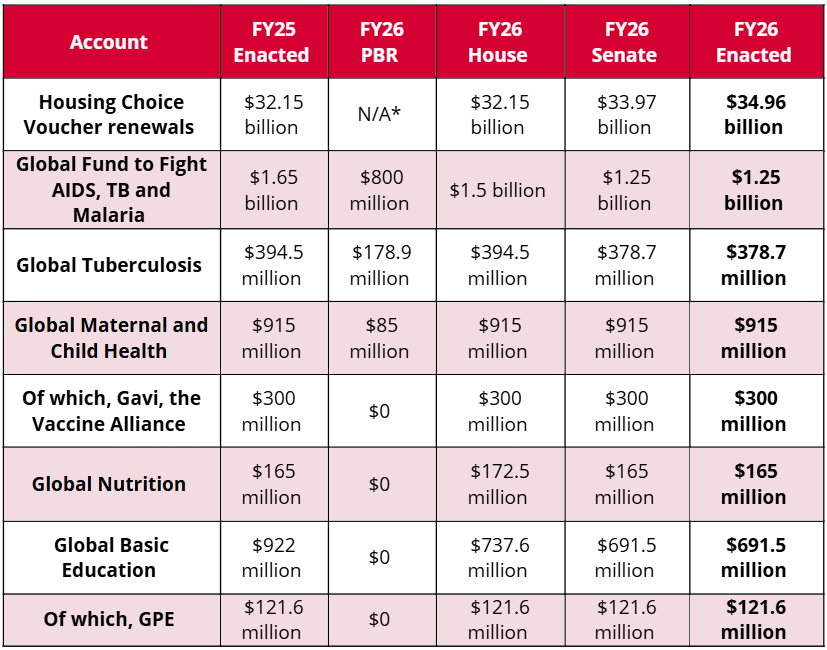
*The FY26 PBR requested combining multiple rental assistance programs, including HCVs, into a block grant, which would be cut by 43 percent.
The FY26 bills also include language that aims to restrict the administration’s plans to withhold money. Congress re-enforced their power of the purse with new guardrails that will ensure the appropriated money is actually spent.
Overall, the FY26 appropriations outcomes are a positive sign that members of Congress are listening to our advocacy. The new funding means families will continue to be able to access health care, housing, vaccines, nutritious food, and basic education. It will save lives in the U.S. and around the world.
Before we turn to FY27 appropriations, you can let your members of Congress know that you’re excited to see this commitment to anti-poverty programs. Thank those who have supported these accounts, and use these talking points to remind them that these programs save lives and fight poverty.