With decades of lifesaving progress on the line, our advocacy is making a difference
We’re living through the most volatile time in RESULTS’ 45 years of advocacy to end poverty. The Trump administration’s attacks on U.S. international aid programs set off a downward spiral, harming millions of people and communities. Trust in the U.S. and our democracy itself has eroded.
But we are still making a difference.
The devastation of U.S. global health and development programs was fast and fierce
By the middle of 2025, the administration had:
- Terminated nearly 100 percent of all existing bilateral tuberculosis (TB), malaria, maternal and child health, and nutrition programs (and the vast majority of HIV/AIDS programs)
- Tried to zero out or slash future funding, and proposed clawing back already allocated funding through the rescissions process, for a broad range of high-impact health programs.
- Withheld promised funding to the Global Fund to Fight AIDS, Tuberculosis and Malaria.
- Announced they would withdraw from Gavi, the Vaccine Alliance.
The harmful consequences of these actions are enormous. But deep, targeted bipartisan advocacy with Congress has had a level of impact that few thought possible under the circumstances.
Advocacy with Congress has a tangible, lifesaving impact
After the White House’s rash actions, we knew that if Congress let global health programs be erased from the budget they would be gone forever. But if Congress stood strong, there would be a chance to rebuild.
Alongside a chorus of partners and fellow advocates, we raised our voices in lobby meetings, phone calls, emails, and media. We told members of Congress that ending global health programs puts millions at risk of disease and death and was against their constituents’ values.
And in one chart you can see the tangible difference that advocacy made.
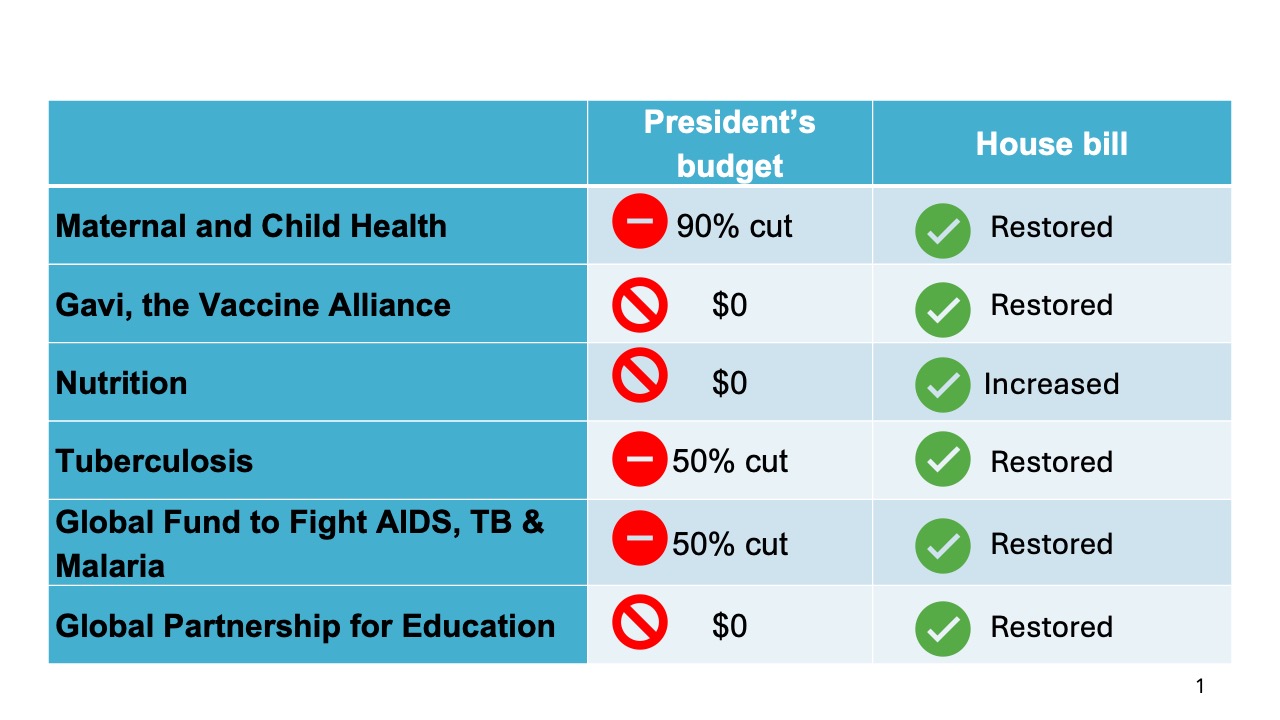
On the left is the Trump administration’s budget proposal for this fiscal year. Global education, vaccines, and nutrition—zeroed out. Maternal and child health—gutted. Fighting infectious disease—slashed in half.
But then something remarkable happened.
The key House committee ignored the administration’s proposal. Instead, their budget fully restores and, in some cases, increases funding for our priority global health accounts.
That’s not all:
- Dozens of terminated global health programs were restarted across Africa, Asia, and Latin America.
- The Senate rejected the administration’s proposed cuts (recissions) to AIDS, TB, malaria, and maternal and child health programs.
- Nearly all funding for TB, maternal and child health, and nutrition programs that was immediately at risk of expiring was invested in global programming.
- Bipartisan members of Congress are rallying behind Gavi, the Vaccine Alliance.
- And in a stunning turnaround, the administration made a new multiyear pledge of $4.6 billion to the Global Fund, reaffirming the longstanding U.S. match.
Protecting these programs is about protecting real lives and communities
These are just some examples of what this funding for global health has meant. In the last few months:
- Tons of emergency therapeutic food were delivered to 13 countries to treat nearly 1 million severely malnourished children.
- The administration rolled out a plan to provide nearly 2 million people with access to a game-changing new HIV preventative.
- Brand new TB testing and treatment programs are now up and running in six countries.
There is no minimizing that the administration’s rash actions continue to have deadly impacts. 2025 is the first year in this century that child deaths have increased. The outcomes above, however impossible they looked this spring, are just a fraction of what they should be in a typical year.
It will take years of focused advocacy to fully recover. And untold lives have already and will be lost in that time. Yet the breakthroughs we saw this year show what’s possible, and what we need to do to make that recovery—and even greater progress—a reality.